NZ games sector shows continued growth as new GDSR data released
New Zealand’s game development industry continues to go from strength to strength, with new data from NZ On Air showing record revenue growth, more games in development, increasing international success, and the important role small to medium-sized businesses play.
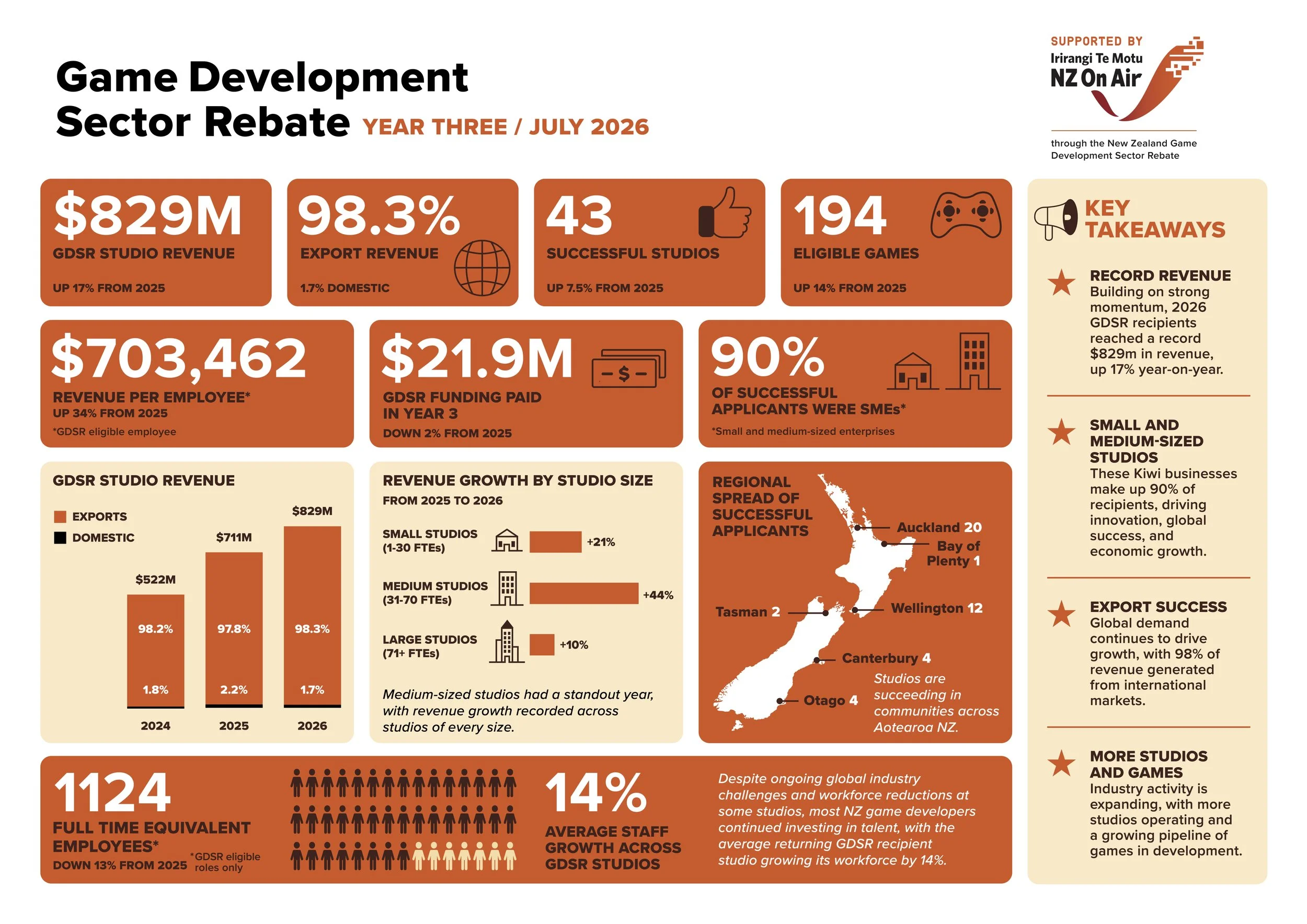
NZ On Air today announced the 2026 Game Development Sector Rebate (GDSR) recipients with $21.9m in rebates distributed to 43 studios.
The data from the 2026 GDSR recipients shows combined studio revenue of $829million in 2025/26, up 17 percent on $710 million the previous year. This supports the NZ Game Developers Association (NZGDA) announcement last month which predicted New Zealand’s game development sector will hit an overall revenue target of $1b two years earlier than expected.
The 2026 GDSR revenue result, which makes up the majority of that $1b industry figure, reinforces the growing importance of the sector as a high-value export industry and significant contributor to New Zealand's digital economy.
The number of game development studios receiving the rebate in 2026 has increased from 40 to 43, while the number of games in development grew from 170 to 194.
Ninety percent of the 43 recipient studios were small and medium-sized businesses, highlighting the crucial role that Aotearoa SMEs continue to play in driving innovation, exports and economic growth.
"New Zealand’s games sector is largely made up of small and medium-sized studios, and these results show just how important they are," says Chantelle Cole, NZ On Air GDSR Programme Director.
“While the industry is increasingly gaining international recognition for producing world-class games, it's important to note that New Zealand's success is being built by ambitious studios of all sizes.”
The strongest individual revenue growth, says Cole, was seen among medium-sized studios, which reported a 44 percent increase in revenue compared with the previous year. Small studios also performed strongly, recording revenue growth of 21 percent, while large studios reported growth of 10 percent.
Deep Field Games, best known for breakout title Abiotic Factor, is a small-sized studio that experienced strong growth in the past year, both in terms of its game's success and realising the team's ambitions.
The studio says the GDSR played a key role in that success.
Henry Feltham from Deep Field Games says: “The continued support of the GDSR has been exceptional, allowing us to focus resources where it counts: the team and the people making Abiotic Factor. It comes with a sense that New Zealand as a whole wants us to succeed, which is a fantastic feeling.”
New Zealand-made games are reaching global audiences and that continues to translate into significant growth in export income.
Export revenue accounted for 98 percent of total revenue generated by recipient studios. As a weightless export industry, games create significant economic value and help diversify New Zealand's export base – creating highly skilled employment opportunities across creative, technical and digital disciplines.
While total full-time equivalent employment across recipient studios decreased from 1,288 to 1,124 during the year, this headline figure doesn’t reflect the full picture. Despite ongoing global industry challenges and workforce reductions, many New Zealand game developers continued to invest in talent, with the average GDSR recipient studio growing its workforce by 14 percent.
Tāmaki Makaurau-based game studio StaplesVR, best known for virtual reality training and simulations, doubled its employee numbers in the past two years, including bringing on experienced developers.
“Over the course of receiving the grant in both 2024 and 2025, the business went from six employees to 15 employees,” says Alex Dallas, CFO at StaplesVR. “While not all of that growth is attributable to the rebate, it allowed us to bring on skilled people which has been quite transformational. It added a level of confidence.”
Overall, in 2026, the GDSR distributed $21.9 million in funding compared with $22.4 million the previous year.
“This reflects a difference in eligible expenditure purely because we had more studios of a smaller to medium size successfully applying for and receiving the rebate this year,” says Cole. “Alongside that, strong overall revenue growth shows that the ecosystem is increasingly resilient and points to the sector continuing to emerge as one of our most successful digital export industries.”