
A Place at the Table: NZGDA's Fight for Game Development in Vocational Education
New Zealand's game development sector employs over 1,400 people and generates close to $759 million in annual revenue. To sustain that growth, studios need a steady pipeline of skilled graduates. So when the government's proposed reforms to the vocational education and training (VET) system threatened to leave our industry without any formal representation in the new skills framework,. we knew we had to advocate strongly.
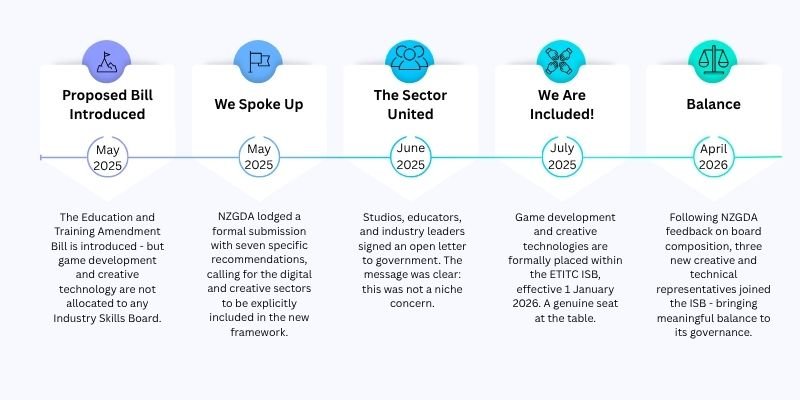
What Was at Stake.
The reform programme was designed to overhaul how vocational education and training is governed in New Zealand, replacing the old structure with a new network of Industry Skills Boards (ISBs). These boards would be responsible for developing and maintaining the qualifications that feed directly into industry, setting the standards for everything from apprenticeships to degree-level training.
The problem: when theEducation and Training Amendment Bill was introduced, game development and the broader creative technology sector had not been allocated to any ISB. The Tertiary Education Commission (TEC) did not provide a rationale for this exclusion, The NZGDA's view was unambiguous: leaving our sector without a formal home in this system would sever the connection between education and employment outcomes, and put the entire talent pipeline at risk.
Our Written Submission
The NZGDA made a formal submission on the bill, laying out in detail what the exclusion would mean in practice. Without ISB representation, our industry would lose its voice in the development of the very qualifications that train future game developers. We made seven specific recommendations, including that the digital and creative sectors be explicitly assigned to an ISB (or that a dedicated ISB be created), that freelancers and non-traditional workers be included in work-based learning provisions, and that Maori representation remain a legislative requirement for ISB governance.
Our core argument was straightforward: this is one of New Zealand's fastest-growing export industries, generating over $548 million in revenue in 2024 alone and on a clear trajectory toward $1 billion. In our view, excluding it posed a genuine structural risk to the sector's future.
Mobilising the Sector
The NZGDA published anopen letter to the government, signed by studios, educators, and industry leaders across game development and the wider creative technology sector. The letter called on government to:
Explicitly include digital technologies in the scope of the ISBs
Recognise game development and interactive media as core to New Zealand's creative and economic future
Align education policy with the government's own investments in the sector, including the Game Development Sector Rebate and CODE
Ensure industry-led, future-focused skills development is embedded in the new system
The response from across the sector was strong, and the message was clear: this was not a niche concern. It affected studios of all sizes and the educators training the next generation of developers.
The Outcome
The advocacy worked. Game development and creative technologies were included in the new ISB framework, which came into effect on 1 January 2026. Our sector now sits within theElectrotechnology, Information Technology, and Creative ISB (ETITC ISB), which is responsible for developing qualifications, setting skill standards, endorsing training programmes, and advising on workforce needs across the creative, IT, and electrotechnology sectors.